Utah Website Builds That Scale
April 10, 2026
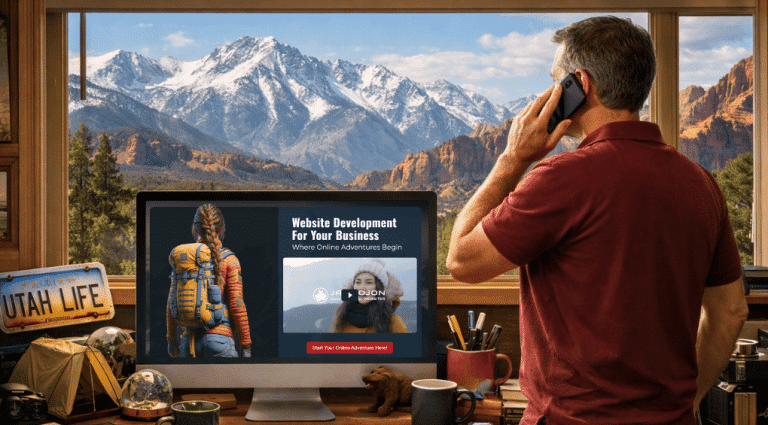
If you are a Utah business and need a website that doesn’t just act like an online brochure but also serves as a lead-generation tool, then read on. This article is for advanced entrepreneurs and growing business leaders who want to harness the power of the internet to increase their revenue and make a bigger impact on their community.
Building to scale means intentionally crafting a website that will grow with you. You won’t need to start over with a new platform or system because your site can’t handle a new software integration. Building to scale also means that your site is designed to attract, collect and nurture leads.
In a recent planning meeting, one of our developers made a comment as we were prioritizing tasks and investments, “We should make decisions based on the future, not just on where we are at right now.” That singular comment has been a guiding pillar for JamboJon in deciding which CRM system to implement. Which content pillars should we develop, and what products can we offer?
When you hire JamboJon to provide you website development services for your business, you aren’t just preparing for the next trade show, the next month’s revenue, or the current engine. You are investing in a system that will scale with your business long term.
What building to scale your website actually means.
Your website should be built to handle growth with technology overtime. These are six areas to be aware of that can help your website scale.
- An intentional link structure, so hierarchy and organization are the standard from the beginning.
- An SEO strategy to build credibility and organic website traffic.
- A security plan that ensures your website will withstand threats from bot traffic and malicious malware.
- Hosting plans that can increase as your traffic and website size grow.
- A trained team, whether a third party like JamboJon, or an internal team that understands your technology, systems, and has access to the tools that make the business move.
At JamboJon we build websites on WordPress, a Content Management System, that is capable of handling a robust system of integrations and data.
Another way to use a website is as lead generation machine. Whether you are selling directly from your website to your customers, or if your website is a gateway to close the sale in person. Your website can work for you to build interest, curiosity and revenue for your business.
What is the difference between an online website brochure and a lead generation site?
I was a child of the 80s. As a kid I remember when my mom invested in an Encyclopedia Britannica set. We had a long, thin side table in our blue living room that held the 20+ collection of books. Rather than going to the library for a research paper, I could pull out an encyclopedia on any given topic to learn about a field of study, a scientific name, or even a country. I would argue that physical encyclopedias, as I had in my childhood home, were the quintessential brochure. It was information to be information. It was documentation of history, facts, and knowledge.
A brochure website can be beneficial. Having information about your business, including facts, stories, and even product offers has its place. Since the beginning of the internet and the first websites, this was the first function of the World Wide Web: to be informational. This type of website is especially helpful for educators, associations, and academic bodies. In addition, this type of website is effective for businesses that rely heavily on in-person sales to develop relationships and close larger accounts, such as professional services firms. But having an online encyclopedia of information does not necessarily translate into new revenue, more leads, or greater impact.
If you’re looking for growth in 2026 for your business, you’ll likely need a lead-generating website to truly move the needle. Want to know more about how JamboJon can help? Let's get on a call.
Transform your online brochure into a lead generation tool.
Make sure you have mapped out your customer’s journey.
Intentionally design their experience from first introduction through the sales process, then to project completion and final deliverables. Simplify what to expect and invite readers to take steps on your customer journey. Map it out. In the plainest language possible, tell them how to start and what’s next all along the way.

Make it easy to say, “Yes!”
Can you imagine walking into a restaurant with a full wallet and an empty stomach, and no one sits you at a table or takes your order? That would be ridiculous. You know as well as I do, you wouldn’t be back and they wouldn’t stay in business for long. Why do we do the same thing on our business website? People are there to shop. Help them shop.
Automate Your systems so you can help the masses.
A great memory is helpful for a school spelling bee, and can be a source of pride for a successful entrepreneur. If you are relying on your memory to make magic, you will only succeed as far as the bandwidth you carry in your own brain. Teams can’t replicate what you know, and customers may not even get a consistent experience from you day to day.
Use a system to carry the weight of growth. A simple lead generation map may include the following steps:
- FREE OFFER.
A free offer on your homepage with a panel and a pop-up window. This step always includes a website form to request a free download. You can begin collecting email addresses with permission to retarget and market to them. Think about developing a relationship with your customers, delivering promised value, and showing up consistently. - INSTANT ACCESS:
After they click “submit,” they will be redirected to an instant-access page featuring their free gift, a video from the founder on how to use it, and the next steps for working together. - EMAIL GIFT:
Simultaneously, they will receive an email with the download, which is attached to a series of emails sent daily or weekly, encouraging them to purchase a product, request a free consultation, or get a quote for a customized product. In this series, you can showcase your offer, tell them the benefits and solutions this product or service provides, and give social proof that other people in this arena have had the result you are touting in your advertisements. - CUSTOMER PURCHASE:
Whether it's from the instant-access landing page, a follow-up email, or even a social media post advertising a paid product, the next step is for

the customer to purchase a product. That sale can happen while you sleep if your website is set up as a lead-generation tool. From digital delivery of a class or book to putting a physical product in a shipping queue for your delivery team, all of this can happen with triggers and automations.
- CRM INTEGRATION:
If your sales cycle is long, your CRM system can be integrated with your website to show you a pipeline of revenue opportunities. You can understand exactly what contacts are in your sales system, and where they are in the process, from having filled out a form online, to having met for a discovery call, or if they have signed their contract. You can track each step through automated software. - TRACKING:
Set up your tracking so it's easy to collect, review, and use the data from your website. If you have five data sources and need to login into multiple systems to see the efficacy of your ads, it's likely you won’t leverage the power of your data to make better decisions or to even see your ROI. A website that scales has information about who is coming, how long they stayed, and what they clicked on. You only know this information if you are tracking